



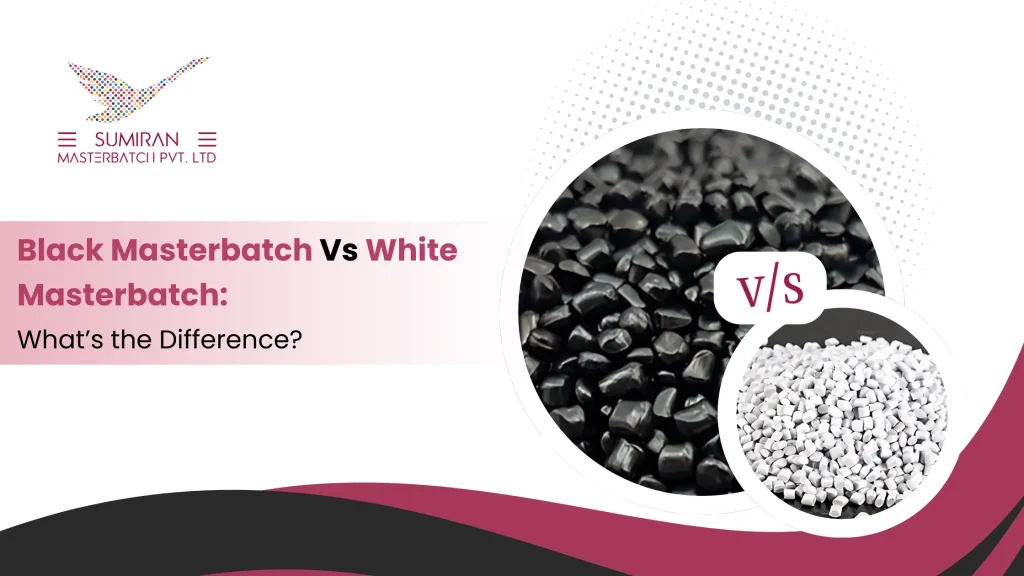
The use of color and performance is interconnected in the plastics industry. Among the various color additives for plastics, the black masterbatch and the white masterbatch are the most widely used in the world, as they are highly adaptable. Although they can both be utilized for coloring, the black masterbatch and the white masterbatch plastics are consistently different in terms of their formulation, use, and performance.
This blog contains a brief plastic color additives comparison. There is a plastic color additives table that highlights their composition and applications.
What is Masterbatch?
Masterbatch refers to a saturated mixture of pigments or additives that is compounded with a carrier resin. The masterbatch comes in granular form. It is further added to the base polymers to create colors or optimize certain properties. In comparison to the use of raw pigments, masterbatch guarantees superior dispersion.
Understanding Black Masterbatch
What Is Black Masterbatch?
Black masterbatch is primarily made using carbon black as the pigment, combined with a polymer carrier resin such as PE or PP. It is widely preferred for its deep black color and excellent UV resistance.
Key Benefits of Black Masterbatch
- Strong UV protection
- High opacity and color depth
- Enhanced durability
- Good thermal stability
Black Masterbatch Applications
Black masterbatch is commonly used in products that require long-term outdoor exposure or mechanical strength, such as:
- Agricultural pipes and irrigation systems
- Industrial containers and crates
- Automotive components
- Wires and cables
A reliable black masterbatch manufacturer ensures dispersion and consistent performance in demanding applications.
Understanding White Masterbatch
What Is White Masterbatch?
White masterbatch uses titanium dioxide (TiO₂) as its primary pigment. TiO₂ provides excellent brightness, opacity, and light-scattering properties, making white masterbatch ideal for aesthetic and functional applications.
Key Benefits of White Masterbatch
- High brightness and whiteness
- Excellent opacity
- Good heat reflection
- Enhanced visual appeal
White Masterbatch Applications
White masterbatch is widely used in:
- Packaging films and containers
- Household products
- Medical and pharmaceutical packaging
- Consumer goods and appliances
Its ability to improve appearance while maintaining performance makes it important in many industries.
Comparison of Masterbatch Types
Below is a simple comparison of masterbatch types, highlighting the core differences between black and white masterbatch:
| Feature | Black Masterbatch | White Masterbatch |
| Primary Pigment | Carbon Black | Titanium Dioxide (TiO₂) |
| Color Strength | Very high | High |
| UV Protection | Good | Moderate |
| Heat Resistance | High | Good |
| Opacity | Very high | Very high |
| Common Industries | Pipes, cables, automotive | Packaging, consumer goods |
| Cost Factor | Economical for durability | Higher due to TiO₂ content |
This table clearly shows the masterbatch performance differences that influence product selection.
Performance Differences in Plastic Applications
Durability and Weather Resistance
Black masterbatch has a high degree of UV protection, hence appropriate for use in outdoor products. White masterbatch, although reflective, might need additional stabilizers to work well when used in outdoor products.
Aesthetic and Branding Requirements
White masterbatch gives a clean and premium look and is the base for light shades. Black masterbatch gives strong and uniform color with less variation in the pigment.
Processing and Compatibility
Both of these masterbatches are compatible with universal polymers such as PE, PP, and ABS. But care should be taken to formulate them correctly so that melt flow, dispersion, and surface finish are not compromised.
Choosing the Right Masterbatch for Your Application
Selecting between black and white masterbatch depends on:
- End-use environment (indoor vs outdoor)
- Required lifespan of the product
- Aesthetic requirements
- Cost and performance balance
Manufacturers usually evaluate these factors through a detailed plastic color additives comparison before finalizing the formulation.
Both black and white masterbatch have significant applications in plastic production. Both have their own strengths. Black masterbatch has strong durability, UV stability, and strength properties. On the other hand, the brightness, opacity, and cosmetic properties of white masterbatch are unmatched. It is important to have knowledge regarding the differences between black and white masterbatch. With the help of an experienced company such as Sumiran Masterbatch Pvt Ltd, businesses can achieve fruitful results in the competitive market for plastics.